Glossaries

The ULPDO serves to advance the mission of the University by continuously publishing a variety of literacy work. Among these books are the following: 

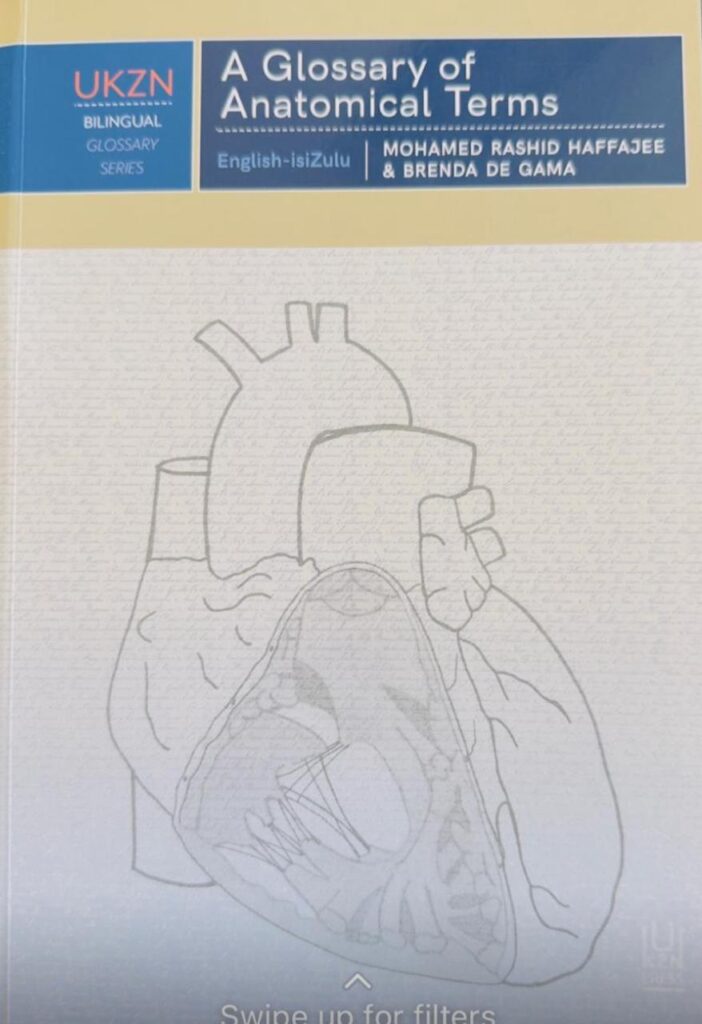
A Glossary of Anatomical Terms

Editor: Mohamed Rashid Haffajee & Brenda De Gama | Published: 2025

Description: Gross anatomy is the study of the body’s visible structures to the naked eye and includes parts of the human body such as bones, muscles, organs, nerves, arteries and veins. As a sub-discipline of human anatomy, it is critical to teach anatomy during the training of future medical and allied health professionals, such as pharmacists, physical therapists and nurses. The teaching of human anatomy uses the English language, although most of the terms are derived from Greek and Latin. It is the origin of the terms that tend to present a challenge to students in easily comprehending the concepts around human anatomy during their learning journey. To ease their understanding, there was a need to simplify the anatomical concepts themselves and make their language more inclusive. This glossary is a bilingual compilation of anatomical terms that are used in the teaching and learning of human anatomy and its various sub-disciplines. This book was developed to assist students who are second-language English users in their anatomy modules but primarily first-language isiZulu speakers, and to enable them to learn and understand anatomy from their indigenous language. Academics can also use it to enhance their anatomy teaching in multilingual settings.
Mohamed Rashid Haffajee qualified in Medicine at the University of Natal in 1979. In 1989, he obtained a Fellowship in Surgery from the College of Surgeons in Edinburgh. He lectured in Anatomy from 1984 to 2014, during which time he also worked in Emergency Medicine.
Brenda De Gama is a Senior Lecturer in the Discipline of Clinical Anatomy at the School of Laboratory Medicine and Medical Sciences, College of Health Sciences, University of KwaZulu-Natal, and she was a postdoctural fellow in the Developing Research Innovation, Localisation and Leadership in South Africa (DRILL) programme. She holds a Bachelor of Medical Science, Honours in Medical Science, Master of Medical Science (cum laude) and Doctor of Philosophy majoring in Anatomy.
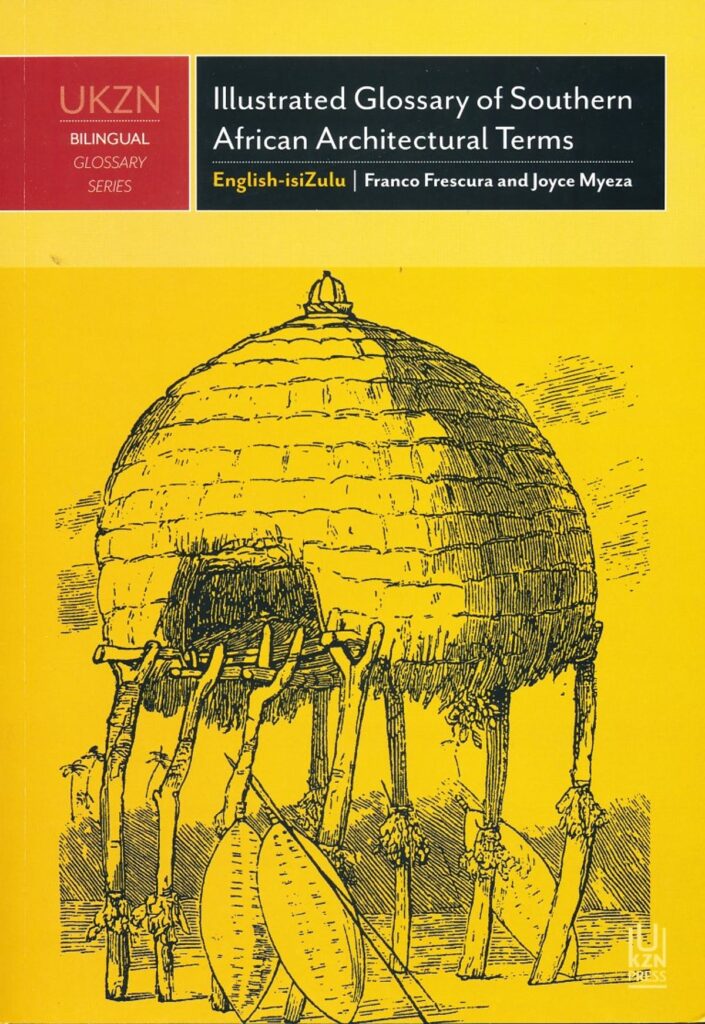
llustrated Glossary of Southern African Architectural Terms

Editor: F Frescura, J Myeza | Published: 2016-11-09

Description: Since 1994 South Africa has undergone a steady erosion of its indigenous built environment, with a concomitant loss of indigenous building technology and its specialised terminology. This glossary is based on the premise that you cannot understand the culture of a people unless you have a grasp of the nuances and hidden meanings of their language and brings together in one single volume the terminologies that are used by southern Africa’s rural builders. It covers the terminology used by indigenous builders as well as subsequent colonial white settlers including buildings of the so-called Cape Dutch, English Georgian, Victorian and Indian Traditions. The text is set out in alphabetical order. It comprises of each term in its original language, its translation where appropriate into isiZulu, and its definition in English and isiZulu. One of the strengths of this book is its visual component of accompanying sketches that expertly illustrate the terms. This book is designed not only to assist in the teaching of architecture, but also to aid others who are interested in the field. Researchers and practitioners in disciplines such as anthropology, archaeology, culture studies and building science will find it a valuable addition to their libraries.

Franco Frescura was Professor and Chair of Architecture at the University of KwaZulu-Natal. He has published widely in the fields of indigenous architecture, colonial settlement and culture conservation. He has lectured in Europe, North America and South-East Asia. In 2010–2011 he was appointed Erasmus Mundus Scholar at the Technische Universität Darmstadt.

Joyce Myeza was a Fulbright Scholar at Simmons College, Boston. She is currently the Director of Libraries and Special Collections at the University of KwaZulu-Natal. Her current research interests include indigenous knowledge systems and enterprise architecture.

A Glossary of Law Terms

Editor: K Zondi | Published: 2018-12-12

Description: The use of African indigenous languages has, for a very long time, been proscribed within the academy. The South African Constitution articulates the imperative to develop these languages in order to treat all official languages equally and to achieve parity of esteem between English and the African indigenous languages. This is critical in order to reverse the legacy of colonialism and apartheid which, wrongly, viewed African indigenous languages as shallow and inadequate. The transition to a democratic society would therefore not be complete without the revival of African heritage, language and identity. This glossary is based on the premise that the South African Constitution is one founded on tolerance and the acknowledgement of the multiple cultural, linguistic and ethnic groups that make up our diverse society. The teaching of law and administration of justice are enhanced if the law made for the people is also available in the languages of those people. This Glossary is thus a first step towards the elevation of African languages in legal education and the practice of law. The book is designed to assist students doing legal studies as well as ordinary South Africans with a limited understanding of law, by providing them with basic explanations of legal terms in both isiZulu and English. It will also be of great value to districts located in the rural areas, where magistrates encounter litigants that only have a command of indigenous languages.

Khulekani Zondi is a lecturer at the University of KwaZulu-Natal, and a member of the Black Lawyers Association. He has strong research interests in the field of legal education, in particular the development of indigenous African languages.